

The Science Of
Musical Colors
The Whole Systems Synthesis Of Sound, Color & Geometry
How Three Arts Speak The Same Language Of Proportion
There are several ways to list the 12 notes in music
Here they are arranged By the Natural Color Spectrum

A Scientific Deep Dive
Sound And Color are Vibrations Of The Unified Field Found In Nature
We believe that bringing music and color together is one of the most natural things to do, just as a handful of great minds have sought to do so in recent and ancient times. We postulate that relatively soon there will be a universally accepted and standardized unification of these two very different but complimentary and proportionally similar artistic languages of music and color, yielding an all encompassing and expanding Unified Musical Colors Theory. In effect, a synthesis between the two disciplines, tied together by the mathematical equation:
VF=(((432^2)•1609.344)
(AF•(2)^40)•10^10)/10
Read About Equation
We assert that frequencies (in hertz) of audible tone frequencies (AF) between 360Hz. and 720Hz. respectively, can be converted to wavelengths (in nano-meters) of visual color frequencies (VF), by transposing upward using the Law of Octaves (i.e. the doubling of audio frequencies repetitively), and divided into what we believe to nodally be the theoretical one-way Speed of Light in miles/second (432 squared, or 186,624 miles per second) converted to meters (i.e. multiplied by the number of meters 1609.344 in a mile). It is important to understand that the second is not just an ever changing arbitrary measurement based on atomic structure, it was originally based on the length of time it takes for a pendulum to make a complete swing through the cycle of an arc of 30º degrees, which is rooted in the origin of ancient measurements (including gravity) having been discovered and not invented by man. In this way, the 7 natural notes in music (A, B, C, D, E, F, & G) are mathematically and scientifically assigned color designations, all determined from their inherently similar proportions and by using the mathematical formula that is represented above.
The Natural Or True “Middle Octave” Found In Western Music
Actually Begins One Tritone Up From Middle C(c4) At The Note f#4
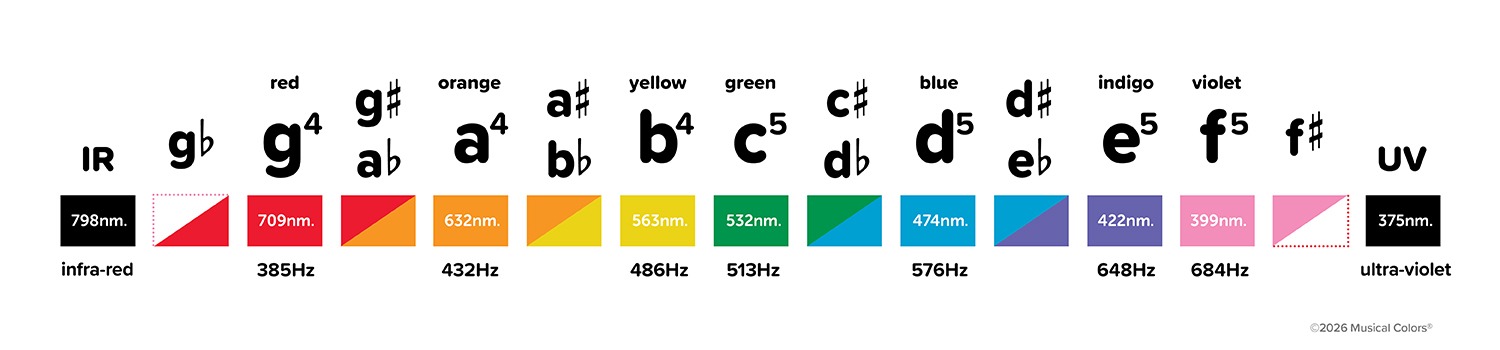
Musical Colors® Scientific Note To Color Correlation
Read About Graphic
Numerical figures above are rounded to the nearest whole number and are the result of taking the average of several tuning systems based on A4 = 432 and A4 = 440 cycles per second, comparatively including Pythagorean, Factor 9 and Equal Temperament tuning. Only the Natural or True “Middle Octave” in music is mathematically related to, and overlaps the Color Spectrum (i.e. from f sharp / g flat 4 to f sharp / g flat 5), which is flanked by the infrared (IR) and ultraviolet (UV) spectrum frequencies. The use of the color Red and Violet to represent the two extreme yet enharmonically unified musical notes g flat and f sharp shown above, visually illustrates how these two natural note colors still remain paired and cyclically stitched to one another to always represent one of the five sharp and flat notes throughout the visual system. Naturals use solid colors and sharps and flats use the two colors of the adjacent natural note colors, side by side, in order to visually distinguish the sharps and flats from the naturals, rather than using the actual shade in between the two, which is impractical.
C Is The Center Of Music Just As Green Lies At
The Center Of The Natural Light Color Spectrum
The Natural Rainbow
Can't See The Whole Rainbow?
The Synesthetic Brain Can See Music And Hear Color! What?
Scientific inquiry has uncovered a compelling link between color and music, demonstrating shared mathematical proportions rooted in the natural order. This intersection is particularly evident in the harmonious correspondence between musical notes and the colors of the visible spectrum, where frequencies align with specific wavelengths. The phenomenon of synesthesia adds an extraordinary dimension, as some individuals seamlessly perceive both color and music in conjoined ways, offering insights into the intricate wiring of the human brain, which hints at the intertwined pathways responsible for processing these sensory experiences. Overall, the scientific exploration of color and music reveals an obvious and profound interconnectedness, from mathematical harmonies to the extraordinary perceptual symphonies experienced by a unique subset of individuals.
- Studies show that color enhances memory retention throughout many disciplines and especially in music.
- Some professional musicians have personal relationships between music and color which help them do what they do best.
- Color coded music systems help to make a positive difference in music education for many children and adults alike.
About Synesthesia
From the dawn of humanity, the mesmerizing dance between music and color has created an intricate tapestry of artistic expression. This profound connection occasionally blossoms into the captivating realm of synesthesia—a neurological phenomenon that transcends the conventional boundaries of sensory perception. In synesthesia, the stimulation of one sensory pathway, such as the auditory experience of music, triggers an involuntary and simultaneous response in another pathway, often resulting in the vivid experience of seeing colors. Picture a symphony transforming into a burst of vibrant hues or a melancholic melody evoking a cascade of cool blues and purples. This extraordinary fusion of senses provides a unique lens through which individuals perceive and interpret the world around them.
Synesthesia, though not universally experienced, has been a subject of fascination for scientists, artists, and philosophers alike. The study of this phenomenon unveils the complex interplay of the brain’s neural networks and the intriguing ways in which different sensory modalities can cross paths. Artists like Wassily Kandinsky, a renowned painter, claimed to “hear” colors, translating the auditory experience of music into visual masterpieces. For Kandinsky, a crescendo might manifest as a riot of warm, energetic reds and yellows, while a gentle melody could evoke serene, cool blues and greens on his canvas. These artists provide tangible examples of how synesthesia enriches the creative process, offering a unique and deeply personal dimension to their work.
As we delve into the profound impact of color, a vibrant mosaic of knowledge emerges. Countless volumes, diverse theories, and extensive research endeavors explore the intricate relationship between color and its effects on cognition, emotion, and aesthetics. Some of these explorations extend their reach into the realm of music, emphasizing the interconnectedness of these two expressive languages. The findings coalesce into a compelling consensus: color serves as a powerful cognitive tool, enhancing memory, simplifying complexity, and providing a visual structure amid the apparent chaos of our environment.
The language of color, with its nuanced palette, possesses the remarkable ability to induce both relaxation and active engagement, fostering deeply meaningful and enjoyable experiences. It acts as a visual symphony, guiding our emotional responses and shaping the narratives of our encounters with art and the world. In this sense, color becomes a silent yet potent storyteller, influencing the way we perceive, interpret, and remember the multifaceted tapestry of human experiences.
In essence, color is a facilitator of a rich, nuanced relationship with the world, often overlooked in the hustle and bustle of our daily lives. Beyond its aesthetic appeal, color becomes a key player in the profound connection between music and human experience. The ways in which color is creatively harnessed to expedite musical learning and enrich individual musical experiences form an integral part of contemporary music education. These practices serve as a testament to the enduring and innovative fusion of color and music, representing a collective journey toward a deeper understanding and appreciation of the sensory wonders that shape our perception of the world.
How do Color, Shape & Sound
Mathematically Fit Together?
Read About Table
The table below should initially be read from the bottom up, starting at what is known as the fundamental primal shape in nature, the Triangle. The music note F#3 or 180Hz. is the bordering infrared frequency at where the 10 Euclidian Shapes, the 5 Platonic Solids, and their respective partnering and increasingly complex 13 Archimedean Solid geometries begin to emanate, adhering to a natural hierarchy of mathematical proportions found in nature, where the most complex geometries compress and share the same sound frequencies, and the Circle is present in all Euclidian geometries. The sums of the interior angles of these shapes individually, when expressed as cycles per second in Hertz, give rise to a mathematical adherence to the proportions of the natural Harmonic Overtone Series (i.e. demonstrated by the partial numbers 1-20 on the right side of the table, of which the 20th partial is where the series goes fully microtonal) and reveal the Golden Mean, Sacred Cut or Ratio, also known as Phi (1.618…). This sacred never ending number is the most irrational number known to man, because it represents the eternal search for perfection. All shapes and solids are listed with (their number of sides 3-12 & 4-180). The Natural Light Spectrum is nicely nested just above the infrared spectrum, between the first octave F#4 360Hz in the series. progressing upward, and terminating before reaching the Ultraviolet Spectrum, the third octave F#5 720Hz. Any frequencies showing an up ↑ or down ↓ arrow, denote the direction either positive + or negative – as to how many cents off from the Equal Temperament musical note the frequency actually is, which adheres to natural Pythagorean unfoldment. Start at the bottom of this table to see how it all mathematically builds up.
THE NATURAL COLOR-SHAPE-
SOUND CORRELATION TABLE
The Ordered Table Shown Below Contains A Naturally Occurring F# Major Triad In Perfect 4 Part Harmony Within An Overtone Series In F# Correlating To All Geometry, The Natural Light Spectrum & More…
The 11 Higher Archimedean Solids

42480˚ Truncated Icosidodecahedron (180) E#^11
42480Hz 4th Major 7th

20880˚ Snub Dodeca-hedron (150) E10

20880˚ Rhombicosi-dodecahedron (120) E10

20880˚ Truncated Icosahedron (90) E10

20880˚ Truncated Dodecahedron (90) E10
20880Hz 3rd Major 7th

16560˚ Truncated Cuboctahedron (72) C10
16560Hz 2nd º5th/+4th/Tritone

10080˚ Icosidodecahedron (60) D#9
10080Hz 2nd Major 6th

7920˚ Rhombicub-octahedron (48) B8

7920˚ Snub Cube (60) B8

7920˚ Truncated Cube (36) B8

7920˚ Truncated Octahedron (36) B8
7920Hz 1st Perfect 4th
The 2 Upper Platonic Solids & 2 Lower Archimedean Solids

6480˚ Dodecahedron (20) G#8
6480Hz 3rd Major 2nd

3600˚ Cuboctahedron (24) A#7

3600˚ Truncated Tetrahedron (18) A#7

3600˚ Icosahedron (20) A#7
3600Hz 3rd Major 3rd (20)
Series Goes Fully Microtonal
The 7 Upper Partials 13-19 & Higher Euclidian Polygons
(3456) A7
3456Hz minor 3rd (19)

(3240) Icosadecagon G#7
3240Hz 2nd Major 2nd (18)
(3096) G7
3060Hz minor 2nd (17)

(2880) Octadecagon F#7
2880Hz 4th Octave (16)
(2736) F↓7
2736Hz ↓Major 7th (15)
(2520) E↓7
2520Hz 2nd ↓minor 7th (14)

(2340) Penta-decagon D↑7
2340Hz ↑minor 6th (13)
The 2 Mid Platonic Solids
Six Mid Partials 7-12
4th Part Of F# Major Harmony
F#6 1440Hz A#6 1800Hz C#7 2160Hz
& 5 Upper Euclidian Polygons

2160˚ Tetradecagon (14) C#7
2160Hz 3rd Perfect 5th

2160˚ Cube / Hexahedron (6) C#7
2160Hz 3rd Perfect 5th (12)
(2070) C↓7
2070Hz 1st ↓º5th/+4th/Tritone (11)

1800˚ Dodecagon (12) A#↓6
1800Hz 2nd ↓Major 3rd (10)

1620˚ Hendecagon(11) G#6
1620Hz 1st Major 2nd (9)

1440˚ Octahedron (8) F#6
1440Hz 3rd Octave (8)

1440˚ Decagon (10) F#6
1440Hz 3rd Octave (8)

1260˚ Nonagon (9) E↓6
1260Hz 1st ↓minor 7th (7)
The 3 Mid Euclidian Polygons
Three Lower Partials 4-6
3rd Part Of F# Major Harmony
F#5 720Hz A#5 900Hz C#6 1080Hz

1080˚ Octagon (8) C#6
1080Hz 2nd P 5th (6)

900˚ Heptagon (7) A#↓5
900Hz 1st ↓Major 3rd (5)
The One Base Platonic Solid

720˚ Tetrahedron (4 sided) F#5

720˚ Hexagon (6 Sided) F#5
720Hz 2nd Octave (4)
ULTRA VIOLET
The 3 Lower Euclidian Polygons
Two Base Partials 2-3
2nd Part of F# Major Harmony
F#4 360Hz And C#5 540Hz
The Natural Color Spectrum Octave
VIOLET F5 684Hz
INDIGO E5 630Hz
BLUE D5 576Hz

540˚ Pentagon (5) C#5
540Hz 1st Perfect 5th (3)
GREEN C5 517.5Hz
YELLOW B4 495Hz
ORANGE A4 432Hz
RED G4 387Hz

DARK RED 360˚ Circle
360˚ Square (4 Sided) Quadrilateral
F#4 360Hz 1st Octave (2)
INFRA RED
The One Base Euclidian Polygon
One Fundamental Partial 1
1st Of 4 Part F# Major Harmony
One Single Bass Note F# 180Hz

180˚ Triangle F#3 (3 sided)
180Hz Fundamental (1)
The Table Shown Above Contains A Naturally Occurring F# Major Triad In Perfect 4 Part Harmony Within An Overtone Series In F# Correlating To All Geometry, The Natural Light Spectrum & More…